BORIS VALLEJO
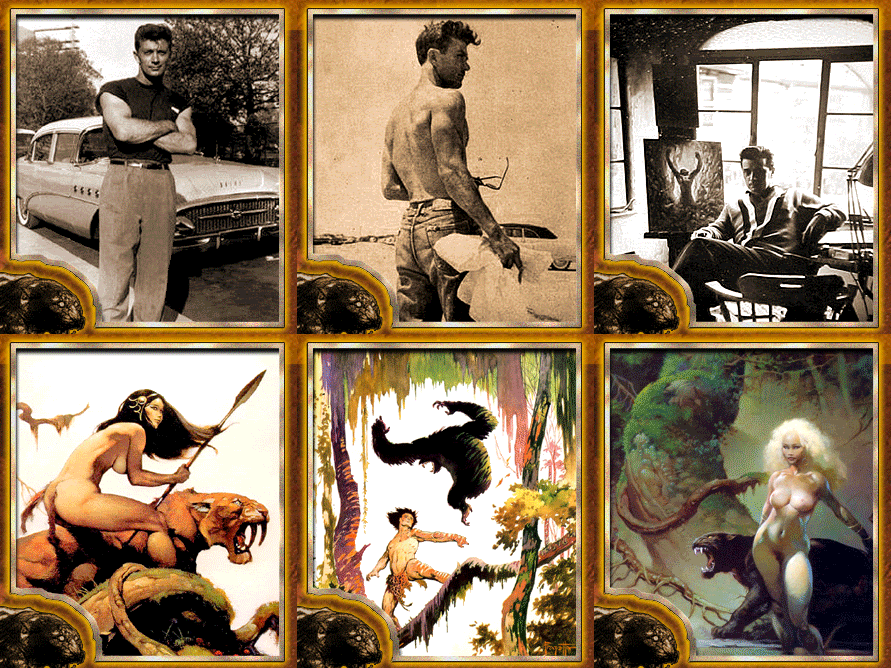
Boris Vallejo was born in Lima, Peru in 1941
Boris Vallejo started off as the son of a distinguished solicitor in Lima, Peru.Originally he wanted to be a concert violinist, not a painter, and so he took violinlessons for seven years.
 But then he decided to study medicine and put his violin back into its case.
After two years, however, he changed his mind again and applied to the Escuela Nacional de Bellas Artes,an art college, where he received a fiveyear scholarship.
It did not take him long to win a much sought-after gold medal for his excellent works. He was 16 years old when he got the offer to study in Fiorentina, a big dream to many, but he refused the offer.
 Vallejo quickly gained in confidence as an artist, and in 1964 he put together a portfolio with some of his works and emigrated to the States.
 He was hoping for a more rewarding career than he could ever have had in Lima. He went with no more than a few dollars in his wallet, and unable to speak the language.
He had no friends but he met a fellow-countryman at a resturant in Bronx, New York. He shared appartment with him for 5$ a week, and the rest of his money to food.
He knew that his money would last that month, so he needed a job quickly.His friend got him a job, his first job was as an illustrator in the advertising department of a chain store,after six month he was transfered to the mainoffice, where he also met Doris, his future wife.After 8 years, however, he decided to go freelance.
He knew that his money would last that month, so he needed a job quickly.His friend got him a job, his first job was as an illustrator in the advertising department of a chain store,after six month he was transfered to the mainoffice, where he also met Doris, his future wife.After 8 years, however, he decided to go freelance.


Having designed fashion, books, cartoons and the title pages for Warren and Marvel's new comic magazines, he then began to work on book covers for several paperback publishing companies already been working successfully as an illustrator for a few years, when I discovered fantasy art an american comic magazin cover.


It was a heroic woman fighting a prehistoric monster, and
suddenly I knew that this was what I wanted to do. I have always had a special love for the perfect structure of the human body, and fantasy art enabled me to depict muscular and sensuous bodies in all variations in my works. And as I love human bodies, I always try to paint them as beautiful and as perfect as possible".

Nearly all his pictures show scenes of savage and effective sensuality.
However, it is not just his choice of subjects that soon made him one of the most popular illustrators of his time, but also his perfect expertise as a painter. Since the end of the seventies alone he has designed more than 300 covers, including "Tarzan", "Conan" and the comic magazine"HeavyMetal".
However, it is not just his choice of subjects that soon made him one of the most popular illustrators of his time, but also his perfect expertise as a painter. Since the end of the seventies alone he has designed more than 300 covers, including "Tarzan", "Conan" and the comic magazine"HeavyMetal".
His vivid pictures all bear the signature "Boris".And Boris is indeed fully aware of the function of his illustrations. "In the bookshops there are always lots of books side by side, and it is often the cover which decides whether a book is bought or not. A successful cover has to attract the potential customer like a magnet." A master of his art, Boris uses his erotic pictures to play on the secret lustful desires of his public like a virtuoso on his violin. But just as he knows exactly what to aim for in his paintings, he is also equally inventive and imaginative in them.  Boris Vallejo's illustrations are never schematic, flat or lifeless. Unlike any other fantasy artist, he keeps finding more and more ways of tantalizing his public. His inventiveness and versatility seem to know no bounds. In fact he has not left a single domain of fantasy art untouched.
 Boris Vallejo's illustrations are never schematic, flat or lifeless. Unlike any other fantasy artist, he keeps finding more and more ways of tantalizing his public. His inventiveness and versatility seem to know no bounds. In fact he has not left a single domain of fantasy art untouched.
Boris is as familiar with the heroic postures of barbarian warriors as with the poetic ambience of a mysteriouslyromantic landscape or the frightening sight of bizarre creatures from an alien world.
The composition and colours of these impressive works of art bear witness to the fact that they have been influenced several hundred years of painting. "Vermeer, Rembrandt, Leonardo -- during my early years I used to study the works of such masters again and again. The painters I liked best were two Spanish ones, though: Murillo and Velizquez." But even today Boris shows great interest in the works of his colleagues. His attitude is anything but complacent and he refuses to rest on his laurels. He keeps watching out for fresh inspiration, continually endeavours to go beyond what he has achieved



 "What always irritated me about him was that he didn't have to work like many other artists do."


 English to Chinese BETA
 English to French
 English to German
 English to Italian
 English to Japanese BETA
 English to Korean BETA
 English to Russian BETA
  English to Spanish